
Al-Ardha dance—or Al-Ardha—is much more than a folkloric spectacle. It is a choreography of identity, collective memory, and national pride that spans centuries of history in Qatar and across the Arabian Peninsula. Traditionally performed before battle to boost morale and reinforce tribal unity, it remains alive today in weddings, festivals, and official celebrations, having become one of the country’s most recognizable cultural symbols.
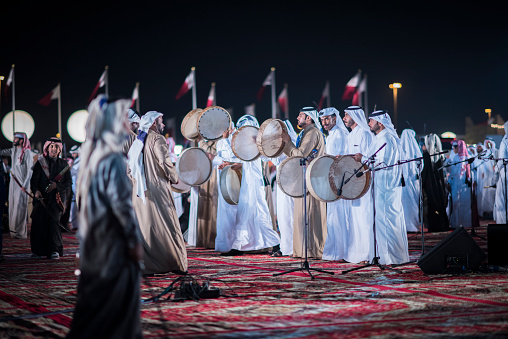
At first glance, the ritual is striking for its visual power. Two rows of men stand facing each other, shoulder to shoulder, advancing and retreating with synchronized movements. In their hands, they hold swords or staffs, which they raise solemnly as the deep rhythm of the drums marks the collective pulse. There are no improvised steps: every gesture is laden with meaning. The swaying of the body represents determination, the raising of weapons symbolizes the defense of honor, the choral singing reinforces the idea of community.
Poetry holds a central place in the Ardha. Participants recite verses that exalt bravery, loyalty, hospitality, and love for the land. These compositions, passed down from generation to generation, function as living archives of Bedouin memory. They tell stories of ancient victories, tribal feats, and moral virtues that remain pillars of Qatari culture.
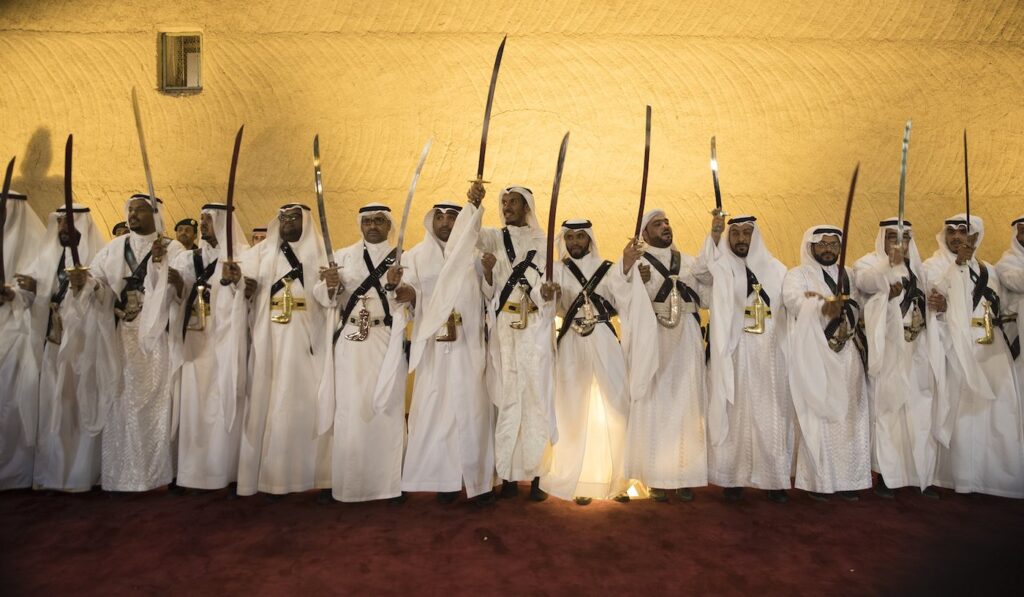
Although its origin is distinctly martial, the Ardha has evolved without losing its essence. Today it is performed on Qatar National Day, at official receptions, and at major public events, where thousands witness it as an act of reaffirming identity. It is also present in private celebrations, especially weddings, where the dance takes on a festive tone without abandoning its symbolic solemnity.
This balance between tradition and modernity is one of the reasons the Ardha remains relevant. In a country internationally known for its skyscrapers, futuristic infrastructure, and ambitious global projects, this dance serves as a reminder that development does not mean a break with the past. On the contrary, Qatar has made its cultural heritage a central element of its international image.
In 2015, UNESCO recognized Al-Ardha as an Intangible Cultural Heritage of Humanity, underscoring its value as a collective expression and a symbol of social cohesion in the Gulf countries. This recognition not only protected the tradition but also placed it on the global cultural map, sparking the interest of researchers, artists, and foreign visitors.
Beyond the spectacle, the Ardha conveys a profound message: strength lies not solely in weapons, but in unity. When the rows advance in unison and voices rise together, the dance ceases to be an individual act and becomes a communal experience. It is the body speaking on behalf of history.
Thus, in every performance of the Ardha, Qatar not only celebrates its warrior past but also reaffirms its cultural present. A reminder that, even in the 21st century, there are dances that continue to be flags, silent anthems, and living gestures of national identity.