
The city of Montevideo, the capital of Uruguay, opens its streets, squares, and gardens like a tapestry, where threads of distant cultures are often imperceptibly interwoven. Among these, the Arab influence stands out in Uruguay’s urban and heritage landscape, a legacy that reached Latin America not only through direct migration but also via the Hispano-Muslim tradition.
A Transatlantic Syncretism
Uruguayan architecture showcases a unique syncretism, blending features of the Alhambra and the Generalife of Granada with modernist rationalism and the needs of an emerging Río de la Plata bourgeoisie. Thus, the echoes of this style did not result from direct, massive migrations from the Maghreb or the Middle East. Instead, they stemmed from cultural and artistic transfers inherited from Spanish rule in Latin America, combined with the travels and interests of local architects. They skillfully interpreted Arab motifs as symbols of refinement, mystery, and modernity.
The Imprint of Julio Vilamajó in the Casa Pérsico
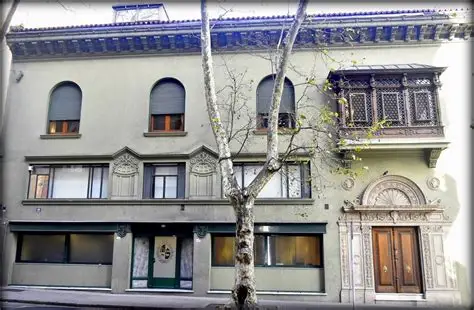
Architect Julio Vilamajó, born in Montevideo in 1894, is a seminal figure at the crossroads of Uruguay’s architectural paths. An extensive journey through Spain, Italy, France, and North Africa in the 1920s left a singular impression on him, particularly the Andalusian and Moroccan architecture. The traces of these styles deeply influenced Vilamajó, who, upon his return, integrated and reinterpreted them within the context of Montevideo’s architectural landscape.
On more than one occasion, the artist declared that the Alhambra in Granada profoundly impacted him, especially the sensuality of its courtyards, the integration of water, the vibrant latticework, and the interplay of light and shadow. It was thus that between 1926 and 1928, Vilamajó designed and oversaw the construction of the Casa Pérsico, a residence notable for its classic Spanish-Moorish style. In this building, the gallery of arches, balconies with wrought-iron grilles, tiled patios, and the mashrabiya-style lattice window that filters the light all evoke the sumptuous mansions of Andalusia. This design incorporates elements of Arab and Islamic traditions, fusing them with features of the Italian Renaissance.
Mansions, Quintas, and Neo-Moorish Palaces
In the El Prado neighborhood, a taste for the exoticism of the Arab style also flourished. The Quinta de Tomás Eastman (or Quinta de las Rosas), attributed to French architect Víctor Rabú in 1880, the Quinta Chinesca of the Fynn family, and the Villa Platero all incorporate Arab elements in their spatial composition or ornamental details. The house at Bulevar España 2525 also features horseshoe arches, latticework, and arabesque motifs. Also of importance is the neo-Arab pavilion for the Ateneo’s kermesse, a work completed in 1896 by Emilio Boix y Merino.
Spaces of Leisure and Fantasy
The taste for the neo-Arab style was also expressed in spaces dedicated to leisure and entertainment, such as the Cine Alcázar, with its façade and decorations inspired by the Alhambra, and the so-called “Cabaret de la Muerte” by José Mazzara. The latter now houses the Dámaso Larrañaga Zoological Museum, which preserves its original minaret and Moorish ornamentation.
The heritage of Arab architecture in Uruguay is expressed through aesthetic and ideological gestures, such as the use of the interior patio as an organizer of space and a source of coolness and sociability. Likewise, it is characterized by the incorporation of horseshoe arches and finely crafted shutters and grilles, the decorative integration of tiles, mosaics, and colorful plasterwork, as well as geometric motifs and plays of light intrinsic to Islamic aesthetics.
This demonstrates that, far from being mere copies of European architectural models, Uruguayan buildings are also nourished by a collective Hispano-Muslim memory, adapted to the local environment to achieve a blend of refinement, functionality, and aesthetic symbolism.