
In the heart of Central America, where the mountains meet the Caribbean Sea, lies Honduras, a country whose architecture bears quiet traces of a distant heritage.
Horseshoe arches, interior courtyards, geometric calligraphy, and floral motifs reveal a tacit but real dialogue that Honduran architecture has maintained with Arab architectural tradition.
Although few recognize it at first glance, the Arab influence left visible traces in cities that were Spanish colonies, in temples, and even in modern houses that look out onto the ocean as if it were a distant mirror.
The Arab Imprint in Honduras: An Untold Story
To understand the Arab influence in Honduras, we must go back to its founding as a republic. For more than seven centuries, Arab and Berber peoples shaped the urban landscape of the Iberian Peninsula. This Mudejar legacy, brought to America by Spanish architects, artisans, and builders, eventually reached Honduras, where its features merged with indigenous clay and tropical wood.
As Honduran architect and restorer Patricia Salgado said, “Mudejar was a form of architectural fusion even before the word ‘fusion’ existed. Its arrival in Honduras via the Spanish created a bridge between two worlds: the Islamic and the American.”
In Honduras, the Arab influence seeps into the details: in tiled, curved roofs reminiscent of houses in Andalusia; in interior courtyards that retain coolness in warm climates; and in wrought-iron balconies where ornamentation serves both function and poetry. The aesthetic of Honduran colonial cities like Comayagua or Gracias still recites, without a voice, the verse of Al-Andalus.
Comayagua: Where Time Speaks in Tiles
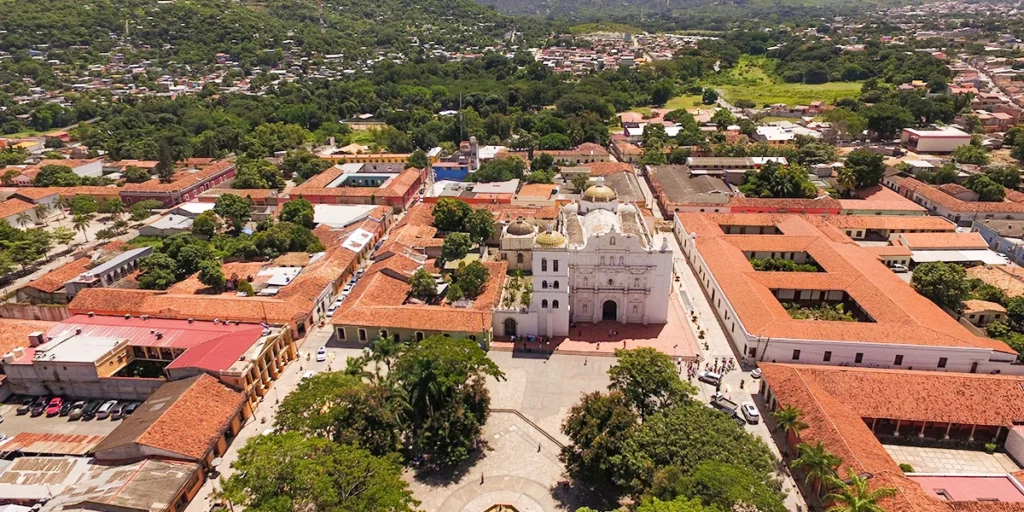
Comayagua is the former colonial capital. Strolling through its streets is like walking through a map where Arabic influences blend with the baked clay and Catholic soul of its temples. In its interior courtyards, covered with glazed tiles and surrounded by fountains, you can feel the echo of Moroccan riads.
Colonial families adopted the enclosed patio design as the axis of intimate and social life—a space where the exterior folds inward, an essential concept of Islamic architecture that makes the patio the beating heart of the home.
The oldest buildings still feature barred windows with lobed shapes and geometric lines. Although the aesthetic was reinterpreted under the Catholic colonial tradition, it still reveals a common thread connecting Honduras to Spanish cities like Córdoba and Granada. This link persists, despite the centuries and oceans that separate them.
The Arab Modernism of Migrants
The 20th century renewed these influences with a human face: Arab families who emigrated to Honduras. They were mainly Palestinians, Lebanese, and Syrians, who brought with them a cultural heritage expressed in their way of life.
The Arab communities established in San Pedro Sula, La Ceiba, or El Progreso helped redefine the urban landscape.
In the 1930s and 1940s, some businesspeople of Arab origin built residences and commercial buildings with Neoclassical reminiscences and Oriental ornamentation. Pointed arches, Islamic-inspired mosaics, and front gardens with discreet fountains appeared in northern cities where family businesses thrived. San Pedro Sula still preserves some facades with geometric details evocative of Mamluk art or the mosaics of Aleppo.
The Arab influence also blended with the mid-20th century Art Deco style. The abstract forms and iron filigrees on portals or balconies reveal an elegant syncretism: Arab geometry reinterpreted by modern Honduran architects.
An Aesthetic of Dream and Contrast
In Honduras, Arab architecture does not appear in a pure form but is reinterpreted. Its strength lies precisely in the blend. The light filtered through latticework, the earthy colors combined with blues and greens, and the contrasts between shadow and water are traits adopted by Honduran architects. In Santa Rosa de Copán, some houses preserve these elements: vaulted portals, cool interiors, and courtyards with orange trees.
The sensitivity of Arab design towards nature and the intimacy of space also parallels the Lenca indigenous worldview, which values the connection of the home with the four elements. In this way, the Arab imprint did not replace Honduran identity but expanded it.
Between Rescue and Future
Today, as the country’s major cities embrace modern towers and glass facades, a group of architects is rescuing the Arab-Mediterranean heritage as part of the national patrimony. In Valle de Ángeles and Santa Lucía, for example, some hotels and vacation homes reinterpret central patios, decorative tiles, and brick vaults. Contemporary Honduran architecture is beginning to see value not only in the colonial but also in the ancestral that resides within it.
At the National School of Fine Arts, several students are working on projects that reinterpret the use of Islamic mosaics in modern contexts. They are exploring geometric patterns that combine Arab tradition with Central American identity. The result is a new aesthetic: Honduran, tropical, and with the soul of the desert.
Memory and Belonging
The Arab presence in Honduras, both in its colonial history and in the contemporary migratory experience, demonstrates that architecture is a silent language that translates encounters. Columns, arches, and courtyards are more than just shapes: they are petrified narratives of mestizaje, memory, and belonging.
On the gate of an old house in San Pedro Sula, an anonymous craftsman drew a spiral arabesque in iron that goes unnoticed by passersby. Perhaps unknowingly, this gesture encapsulates centuries of dialogue between East and West. There, in that elegantly curved line of metal, the legacy of a civilization that crossed seas and centuries remains alive, discreetly, in the walls and soul of Honduras.