
Guatemala’s cultural diversity is not only reflected in its languages, cuisines, and traditions but also in its architecture, where Mayan, colonial, and modern heritages coexist. Within this rich tapestry lies a less obvious but fascinating legacy: the Arab influence, which reached the country through Spain and left its mark on both historical buildings and contemporary expressions.
The Journey of the Arab Style to the Americas
Arab architecture did not arrive in Guatemala directly. Its journey first passed through the Iberian Peninsula after centuries of Muslim presence in Al-Andalus, present-day Andalusia. The Mudéjar style, born from the fusion of Arab and Christian elements, became one of the most significant artistic bridges. With the Spanish colonization of the American continent, this architectural language was transferred to the New World.
In Guatemala, the first colonial buildings integrated Mudéjar elements. Carved wood, the use of tiles, coffered ceilings, and semi-circular arches are all examples of this cultural transfer. Although many buildings suffered damage from earthquakes over the centuries, this heritage can still be recognized in temples, convents, and old houses.
Traces in Antigua Guatemala: Epicenter of the Arab Legacy
Antigua Guatemala is perhaps the place where the features of Arab architecture are most perceptible in the Central American country. The interior courtyards with fountains not only addressed a climatic need in a warm country but also followed an Islamic tradition that conceived water as a symbol of life and peace.
The cloisters of some convents also reflect this heritage. The corridors surrounding interior gardens evoke the layout of Andalusian palaces, where central areas were designed for contemplation and rest.
The coffered ceilings with symmetrical geometries, thick walls, and ornamental plasterwork express the Mudéjar influence in harmonious fusion with the region’s Creole style, creating spacious, cool spaces protected from the climate while being decorated with the distinctive elegance of Islamic art.
The vaults in some churches of Antigua Guatemala were built with interconnected semi-circular arches, forming quadrangular structures, a technique rooted in a tradition also of Islamic origin. The mosaics used in temple floors and hallways evoke the geometric patterns characteristic of the Islamic architecture of Al-Andalus.
Guatemala City: The Mozarabic House
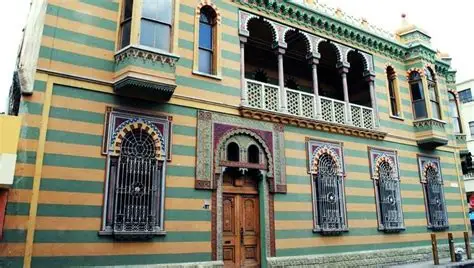
In Guatemala City, a notable example is the so-called “Mozarabic House,” located in zone one of the capital. This house stands as one of the architectural jewels of Arab inspiration in Central America, with its façade decorated with horseshoe arches, plasterwork finishes, the use of vibrant colors, and wrought-iron lattice screens.
The combination of arches and ornaments on its exterior and the layout of its interior courtyards make it a concrete reference for the Mudéjar legacy in Guatemalan residential architecture.
Numerous traditional homes in the capital still maintain central courtyards, solid whitewashed walls, Arab roof tiles, and wrought-iron window grilles—all elements inherited from Andalusian urban design. The use of fountains, plants, and tiles in the decoration of interiors and patios also originates from Islamic symbolism and the pursuit of both thermal and aesthetic comfort.
The Arab heritage in Guatemala reminds us that the journeys of architecture are not confined to a single time or space. This legacy demonstrates that Guatemala is part of a cultural network much wider than it might initially appear.
The history of its people is also written in stone, wood, and tiles. Looking closely at these details allows us to recognize the depth of a dialogue that began over a thousand years ago and remains alive today in Guatemalan corners where East and West once joined hands.